In this account from Mark, Jesus had compassion. This word, splagchnizomai in Greek, comes from the root splagchnon (meaning “bowels”) which has a sense of a visceral, gut-level form of compassion. It intrigues me that this deep, embodied compassion prompted Jesus to teach.
Leading up to this moment, Jesus is trying to get away, to rest. His disciples row him toward the people; however, he is compelled by compassion to teach. As he is teaching, I imagine the crowd turning to one another—What did he say?—repeating his words, passing them along.
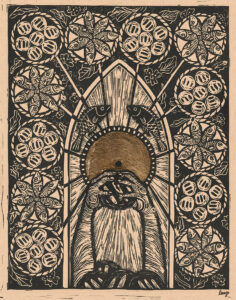
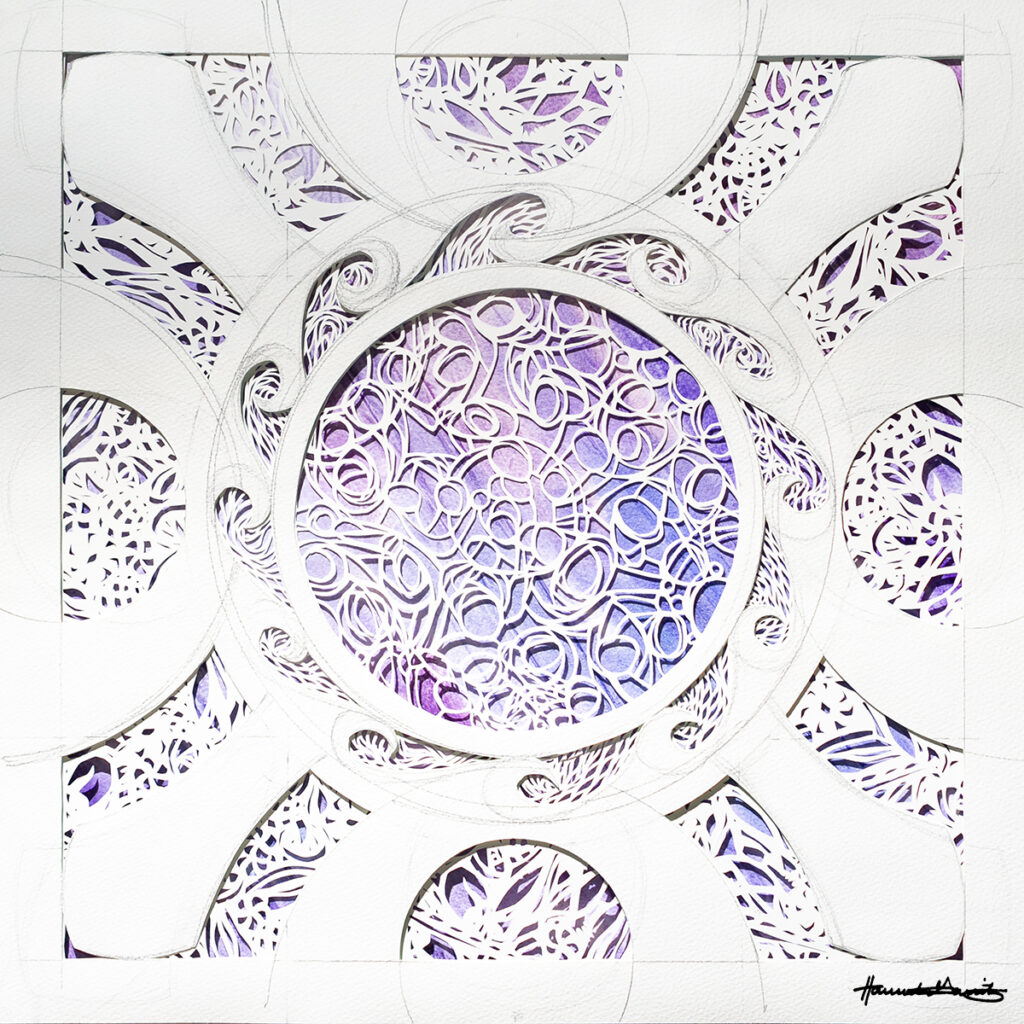
In this artwork, the elements of the story are framed in a stained glass window design. Centered, the people gather in circles, passing the scarcely abundant food to one another. Waves encircle the crowd, representing the twelve disciples. The outer architectural elements portray the twelve baskets full of pieces of bread and fish—a representation of abundance from scarcity, powered by collective belief.
Jesus did not have a microphone. It was the people in the front who passed the still, small voice of God back to those behind them. It was the people in the front who passed more than enough food back to those who were hungry. In our propaganda-filled global information system, we must remember: God is not holding the mic. God is present in the still, small voice and in the smallest offerings, multiplying one by one. The message, the compassion, the corners of bread, and the pieces of fish all return in abundance.
– Hannah Garrity

One Comment
Stephanie
Our tree is a reflection of our family… from bulbs that I was given as a child, to specialty ornaments that reflect our hobbies, to ornaments which the children have made over the years. We decorated the tree last night and I found the ornaments which I enjoyed the most were the ones with the children’s pictures inserted. Was R ever that little? Did M make that? This morning the room smells like the forest. Amen.