
'all are welcome' Tagged Posts

AGAPE (David Scherer)
Hip Hop in the sanctuary of The Table at Central UMC Sunday, April 6 10:30 am 5265 H Street Sacramento, CA 95819 All are welcome.

I read this Ephesians text alongside the feeding of the five thousand. I placed Jesus at the center of the image, but he did not feed the crowds alone. He asked his disciples to offer what they had. They responded with meager resources, yet those small gifts were enough.
Through the lens of Ephesians, if Jesus were to ask us today what we have to give, our answer would be: We have the power you have given us to do the impossible. The same power that turned five loaves and two fish into a feast for thousands—with leftovers—empowers us “to accomplish far more abundantly than all we can ask or imagine.” Do we allow this truth to settle into our bones and animate our actions?
I’ll admit, I tried to avoid this passage because it felt overly optimistic in light of today’s world. People still go hungry. Wars rage. The earth groans under our misuse. Yet if we reimagine the systems we created, studies show it is possible for every human being to have what they need. That would require massive restructuring, international cooperation, and the reallocation of resources—but not more than we already possess. We don’t need a miracle of multiplication. We simply need to use what we’ve been given.
In a world convinced of scarcity, this is astonishingly good news. We already have enough. And as my mentor used to say, “Enough is abundance.” What will we do with this abundance? Is it too lofty to dream of a world that sustains all of life? Perhaps. Yet I believe it is God’s own desire that all may have life, and have it abundantly. This is the work before us, accomplished through the power at work within us, through Jesus Christ. Amen.
– Rev. Lauren Wright Pittman
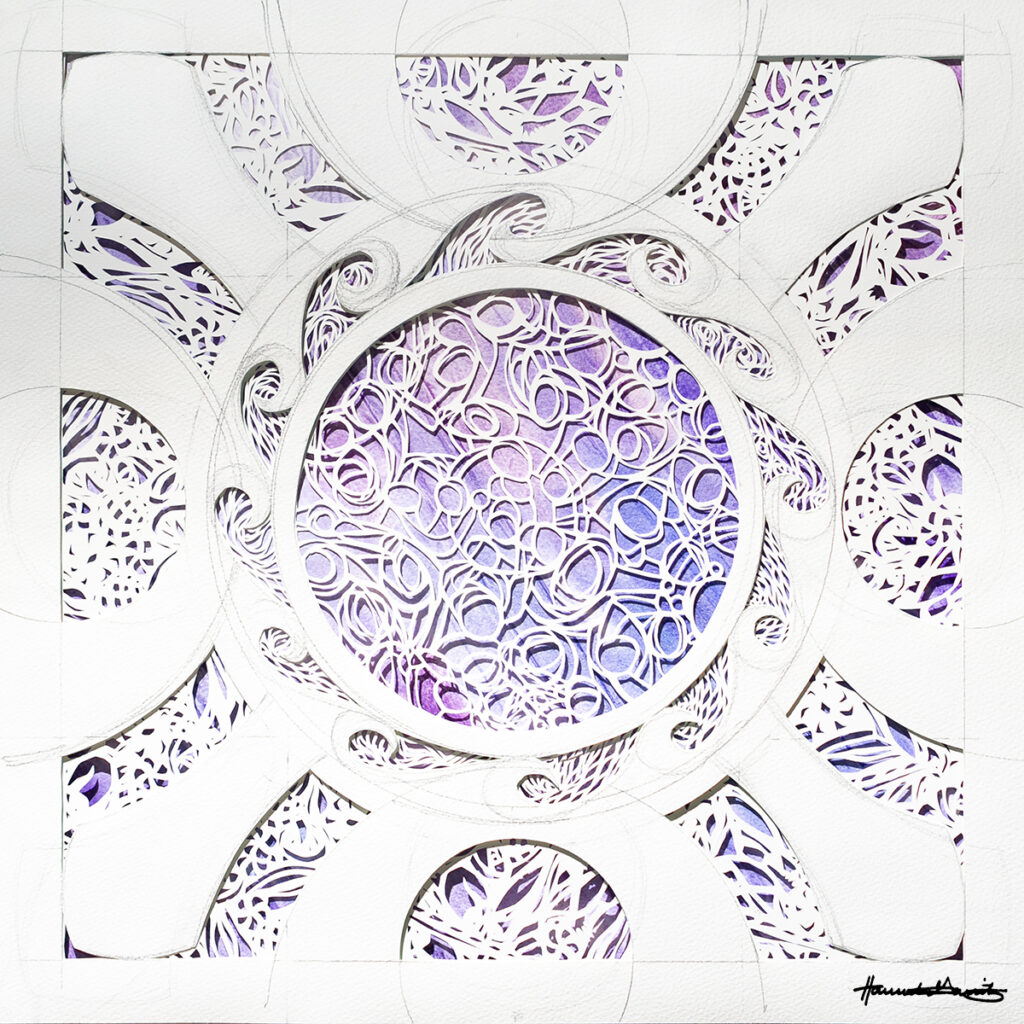
In this account from Mark, Jesus had compassion. This word, splagchnizomai in Greek, comes from the root splagchnon (meaning “bowels”) which has a sense of a visceral, gut-level form of compassion. It intrigues me that this deep, embodied compassion prompted Jesus to teach.
Leading up to this moment, Jesus is trying to get away, to rest. His disciples row him toward the people; however, he is compelled by compassion to teach. As he is teaching, I imagine the crowd turning to one another—What did he say?—repeating his words, passing them along.
In this artwork, the elements of the story are framed in a stained glass window design. Centered, the people gather in circles, passing the scarcely abundant food to one another. Waves encircle the crowd, representing the twelve disciples. The outer architectural elements portray the twelve baskets full of pieces of bread and fish—a representation of abundance from scarcity, powered by collective belief.
Jesus did not have a microphone. It was the people in the front who passed the still, small voice of God back to those behind them. It was the people in the front who passed more than enough food back to those who were hungry. In our propaganda-filled global information system, we must remember: God is not holding the mic. God is present in the still, small voice and in the smallest offerings, multiplying one by one. The message, the compassion, the corners of bread, and the pieces of fish all return in abundance.
– Hannah Garrity
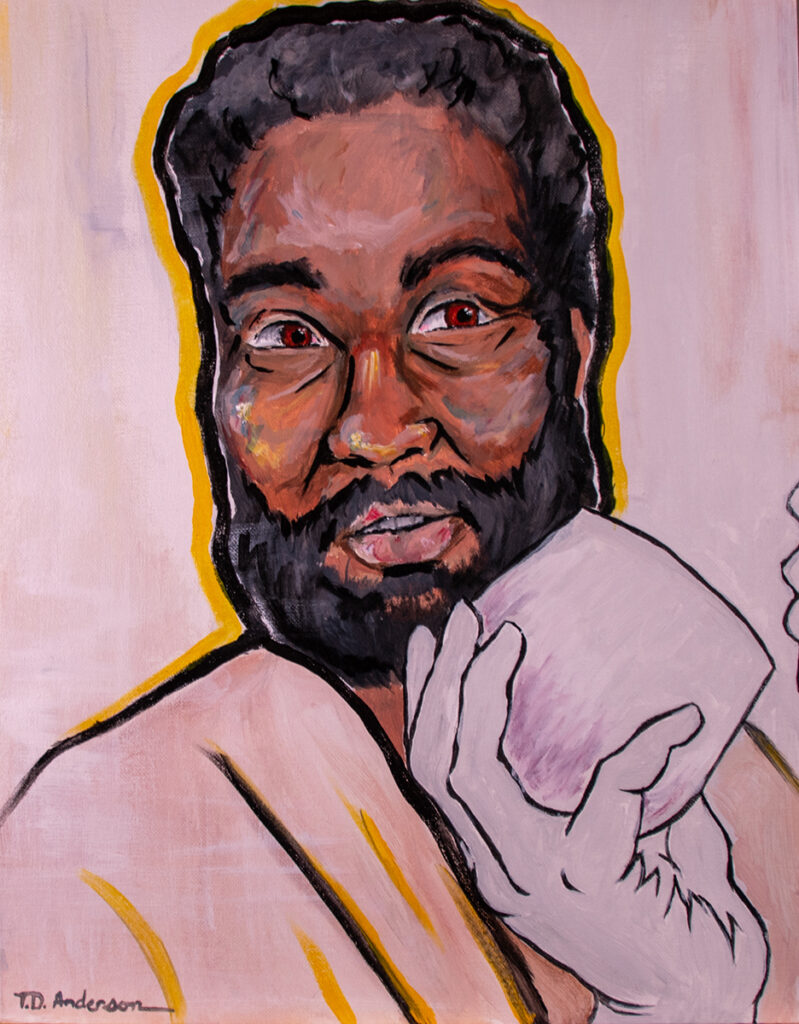
The Wedding at Cana is my favorite text because there is a lot of humor in it. There’s humor in a mother approaching her son and telling him to do something without ever actually telling him to do it. There’s his pouty resistance to his mother’s non-demand while she completely ignores him and paints him in a corner. There is humor in a raucous wedding reception where the people are so “lit” that the wine has run out. And, for me, it’s particularly humorous that there’s this huge, beautiful secret of which only a few people are aware.
Those people include Jesus’ mother and the select servants who help him pull off the miracle that inaugurates his ministry. Servants are normally meant to be inconspicuous, so I wanted to focus on the servant who goes to the chief steward with a cup full of what, as far as he’s concerned, is water.
If Jesus—whose ministry has not started, so there haven’t been any wonders associated with him yet—tells you to fill jars with water and draw from the jar to give to the chief steward, what is going through your mind at that moment? I invite the viewer to focus on this servant and all his curiosity and expectation, and think of a time when you were surprised by something God did. What actions preceded the miracle? Did it make sense? What did you know, and what was hidden from you? What “secrets” might God be keeping from you now as God works clandestinely on your behalf?
—Rev. T. Denise Anderson