Sermons by Rev. Greg Bergquist

GOOD NEWS IS LOUDER THAN FEAR 11:00pm
Luke 2:13-20
GOOD NEWS IS LOUDER THAN FEAR 5:00pm
Luke 2:7-20, (NRSV)

WHEN YOU’RE AFRAID, GIVE ME YOUR HAND
Matthew 1:18-25, Isaiah 41:5-10 (NRSV) The theme for the fourth week of Advent is “When you’re afraid, give me your hand!” “Give me your hand” might be counter to how we usually respond to fear, but what if fear can result in connection instead of isolation? Joseph moves through his fears of rejection and shame in order to stand in solidarity with Mary, shielding her from harm. Their bond makes them each stronger. We don’t live out our callings in…
INSISTING ON HOPE THIS ADVENT
Luke 1:5-13, Lamentations 3:55-57 (NRSV) “In the time of Herod …” places Jesus’ birth in a world shaped by political unrest, societal uncertainty, violence and fear. In this context, Luke introduces us to Elizabeth and Zechariah – an aging childless, priestly couple whose life is centered on a deep longing and faithful waiting. This intense longing and waiting creates a particular kind of fear. Although it invokes an “inner shaking, a disruption of body and spirit,” it is not a failure.…
DEEP COMMITMENTS: REFLECTION
Luke 2:41-47 John Wesley, the founder of the 18th Methodist movement and what became the worldwide Wesleyan tradition, was an advocate for theological reflection and education for all people (regardless of their social status). Embracing the intellectual component of our humanity, he believed that “reading Christians are growing Christians. When Christians cease to read, they cease to grow.” Consequently, he believed that reason (along with experience, scripture, and tradition) is one of the fundamental sources we draw upon in order…
Roots and Home
This week, in order to find God in our midst, we look into our family and the families we create together. Diana Butler Bass notices that sometimes we find wisdom in the oddest places, “for example, in a real-estate blog. Blogger David Marine writes:” ‘The English word “home” is from the Old English word hâm (not the pig), which actually refers to a village or estate where many “souls” are gathered. It implies there’s a physical dwelling involved, but the…
Neighborhood and Commons
This week, in order to find God in our midst, we look into our own neighborhood. Diana Butler Bass reminds us of this simple, yet profound reality by quoting that famous theologian, Fred Rogers: “It’s a beautiful day in this neighborhood, a beautiful day for a neighbor. Would you be mine? Could you be mine? I’ve always wanted to have a neighbor just like you. I’ve always wanted to live in a neighborhood with you.” Worship online with thetable.live. CCLI…

Sky and Air
This week, in order to find God in our midst, we look into the vastness of the sky and heavens and take a deep breath to fill our lungs with life giving air. Diana Butler Bass believes that our experience of God is paradoxical, at times. That is to say, our encounter with God is often one of the most mysterious and intensely personal experiences in our life, all at the same moment. As Bass says: Unlike the ground and…
Genesis
This week we begin at the beginning in both the Hebrew Scriptures (Genesis) and the New Covenant (The Gospel of John). Diana Butler Bass contends that our understanding of God and Jesus in the role of Creator (i.e., Genesis as the original act of creation and as a dynamic creative process that extends throughout history) is drifting away from the dominant theology of top-down, vertical institutions that describe God as the “majestic, transcendent, all-powerful, heavenly Father, Lord, and King” to…
Radical Grace
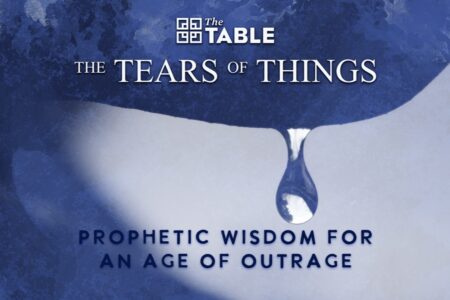
This week we take our ninth and final step along the path of the prophetic tradition. Richard Rohr in his book, The Tears of Things: Prophetic Wisdom for an Age of Outrage, reminds us that the prophet Ezekiel (perhaps one of the most quirky and eccentric prophets we have read) begins in usual prophetic fashion with anger but then turns to one of the clearest expressions of grace in the Hebrew Scriptures: namely, the people receiving a “new heart and…
The Alchemy of Tears
This week we take our eighth step along the path of the prophetic tradition. Richard Rohr in his book, The Tears of Things: Prophetic Wisdom for an Age of Outrage, reminds us that there is only one book in the Bible named after an emotion: the book of Lamentations, an expression of the “tragic sense of life.” Author and storyteller Megan McKenna poignantly describes the grief bemoaned by the writer of Lamentations, … the universal nature of shared sadness, and…
The Role of Anger
This week, our youth apprentices and interns from Table Farm ask us to consider the role of anger on the prophetic path as evidenced in the lives of the biblical prophet, Jeremiah, and modern-day prophet, Greta Thunberg. During their recent farm shifts, our youth explored the connection between anger and grief as an antecedent to hope. Swedish climate activist Greta Thunberg embodies these two seemingly opposite and challenging emotions, anger and grief, as she chastises world leaders for not taking…
- 1
- 2